
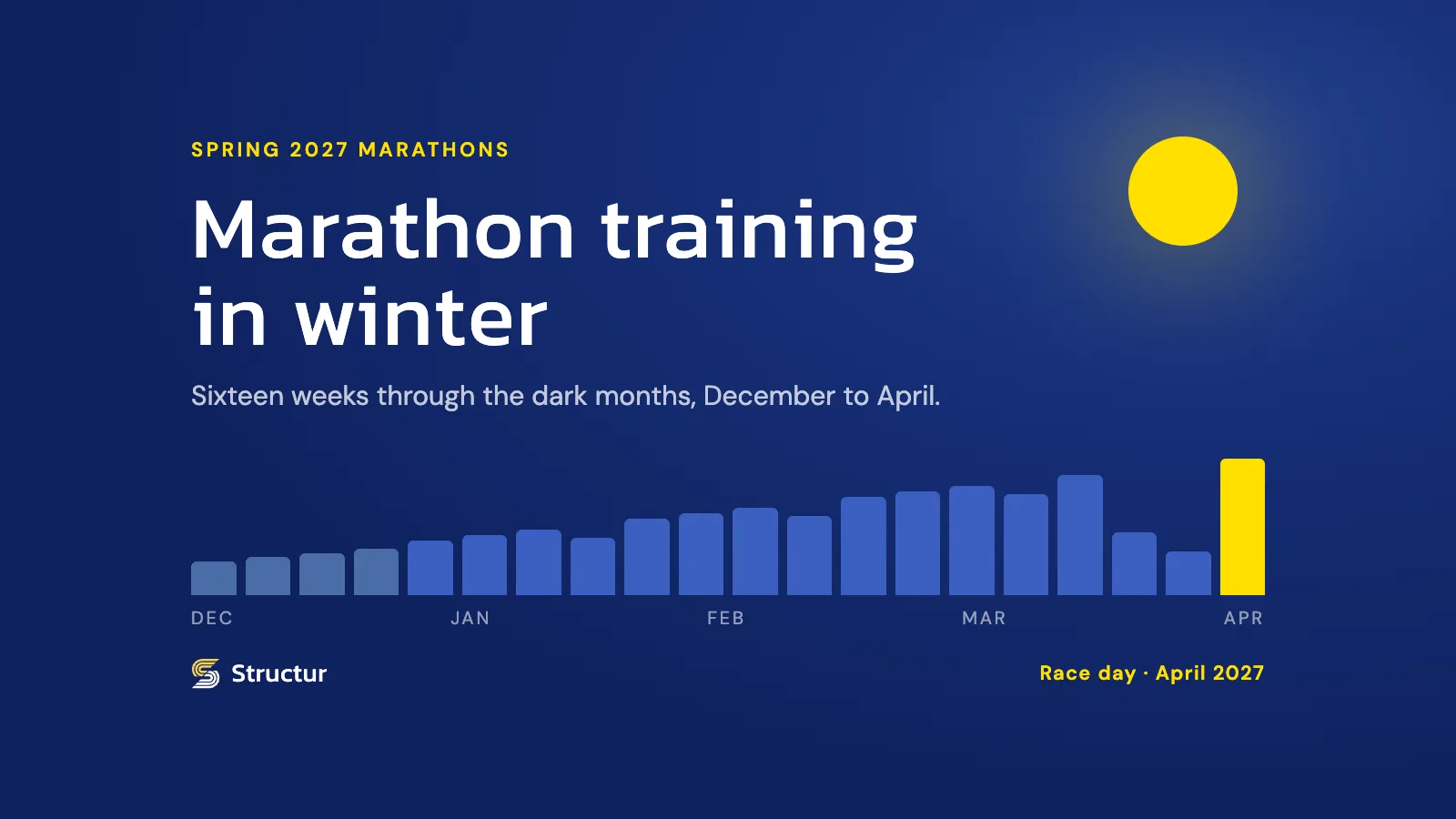

It's time. Winter is here and marathon training in winter is how almost every spring marathon gets built. Count 16 weeks back from the Manchester Marathon on 18 April 2027 and the plan starts on 28 December. For London on 24 and 25 April, it starts on 4 January. So the hard weeks fall in the darkest, wettest part of the year. The cold itself is the smallest of the problems. Darkness, ice, illness and Christmas cost far more training. This guide covers each one, with a sample week at the end.
When to start marathon training in winter
Marathon training in winter starts with the race date, counted backwards. A 16-week plan for a mid-April race begins in the last week of December or the first week of January. That leaves December for building a base, not for training hard.
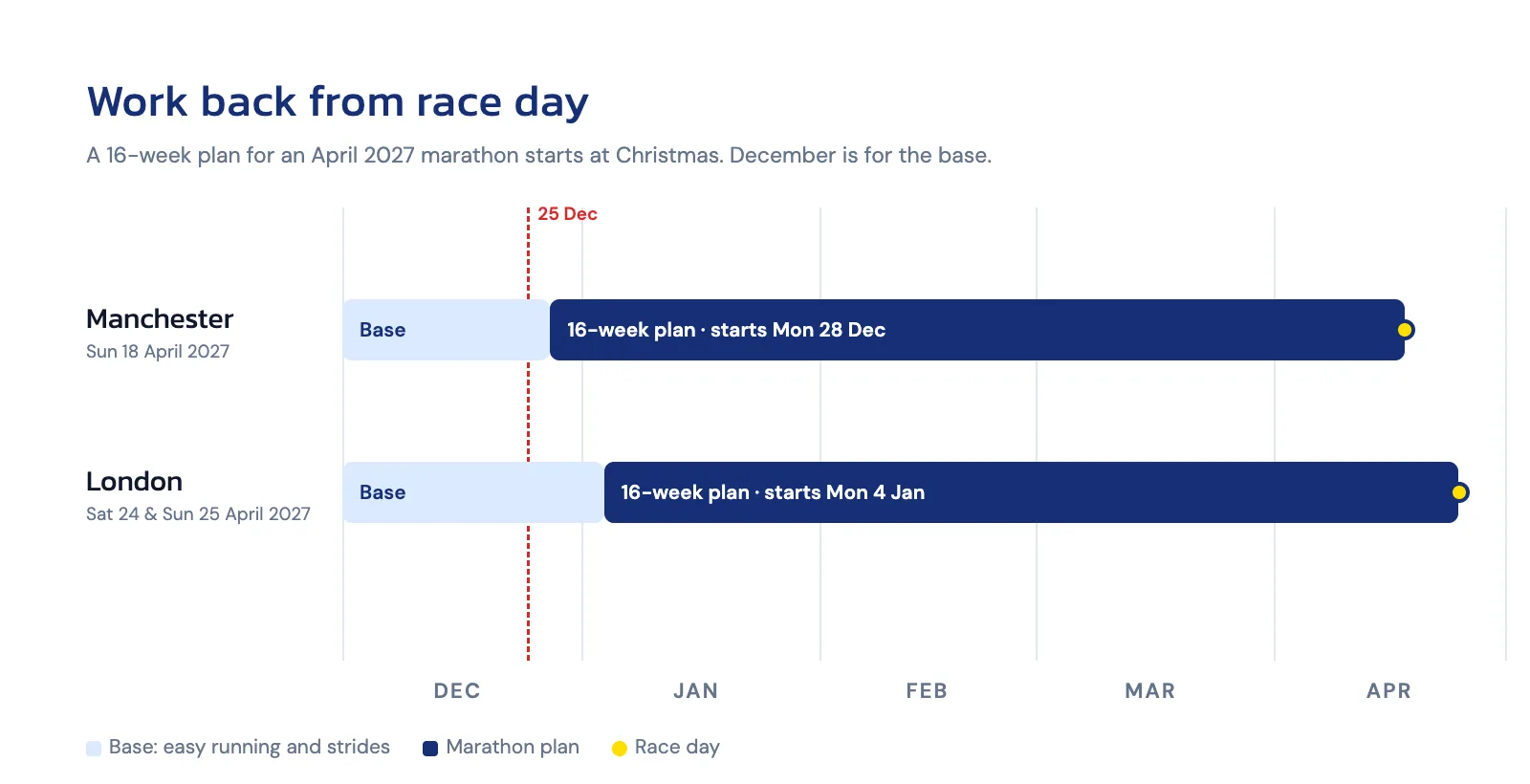
December has one job: arrive at week one already running regularly. Four or five easy runs a week, a few strides, and a long run that creeps towards 75–90 minutes is plenty. Most of that running should be easy, as our guide to zone 2 marathon training explains. Do not start the plan early because you feel keen. A plan that begins in late November simply peaks too soon, and the last month turns into survival rather than sharpening.
Next, set your paces before the plan begins. A recent race or time trial gives you a threshold pace, and that sets every other pace. Our threshold pace calculator and training paces calculator do the arithmetic. If you have a goal time, the marathon pace calculator shows the pace per kilometre and the splits.
Is cold weather bad for marathon training in winter?
Not for a marathon runner, within reason. A study of almost 1.8 million finishers across six major marathons found that the best temperature for marathon speed was between 3.8 °C and 9.9 °C. The exact figure depended on the runner's level. Speed fell away on both sides, but heat cost far more than cold. Similarly, an earlier analysis of seven American marathons found that times slowed steadily as conditions warmed from 5 °C to 25 °C, and slower runners lost the most.
Now compare that with a British winter. Met Office records for 1995 to 2024 put the UK's average daytime high at 6.7 °C to 7.5 °C from December to February. In other words, the middle of the day sits inside the range where marathons are run fastest.
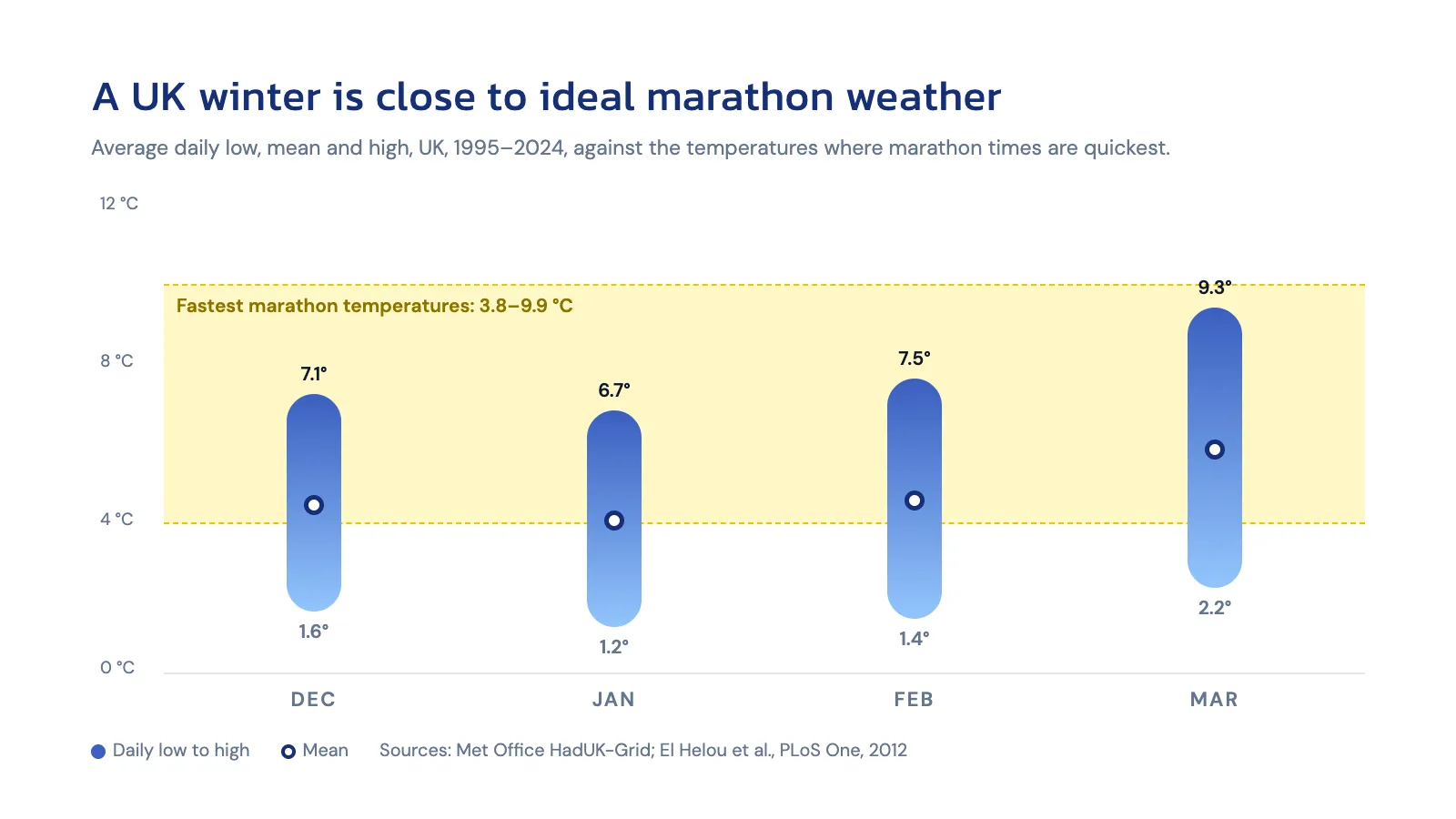
So the cold rarely makes marathon training in winter slower. Wind, rain and ice do. On a wild day, run by effort or heart rate rather than pace, and expect the watch to read slow.
Warm up for longer
Cold muscles produce less power. A review of temperature and muscle function found that short efforts improve by 2% to 5% for every 1 °C rise in muscle temperature. That matters for strides, hill reps and threshold sessions, not for easy running.
Before a hard session in winter, therefore, jog for 15 minutes rather than 10. Then add a few drills and four strides. Keep a layer on until the first rep and put it back on straight after the last. If you can, start into the wind and come home with it behind you. That way you are not running into a cold wind while you are sweaty and tired.
Running in the dark
For most people with a job, winter means running before sunrise or after sunset. The Highway Code is specific about being seen. Rule 3 of the Highway Code says to wear something light or fluorescent in poor daylight. In the dark, it says to wear reflective material, which drivers can see in their headlights up to three times as far away. Rule 2 adds that where there is no pavement, you should keep to the right, facing oncoming traffic.
In practice, that means a few habits:
- A head torch so you can see the ground, plus a rear light so drivers can see you.
- Reflective bands on your ankles and wrists, as well as a reflective top.
- Lit routes you know for easy runs, so you are not looking at a map in the rain.
- Interval sessions on a track, a lit loop or a treadmill, never on dark, unfamiliar roads.
Ice, snow and the treadmill
A slip on black ice can end a marathon block in one step. When pavements are frozen, move the run indoors or swap the day. One missed easy run costs nothing. A broken wrist costs the race.
The treadmill is a good place for structured work in winter. Set the incline to 1%. In a study of trained runners, a 1% treadmill gradient matched the energy cost of road running across speeds from about 5:42 to 3:20 per kilometre. Without that incline, the same pace costs less than it would outside, because there is no air resistance.
Threshold and marathon-pace sessions suit the treadmill well. The pace is exact, the surface is even and you can see every split. Long runs, on the other hand, are better outside where possible. Try to run them in daylight at the weekend, when the roads have had time to thaw.
What to wear, and breathing cold air
Dress for the second half of the run, not the first five minutes. A thin base layer, a light windproof jacket, gloves and a hat cover most UK winter days. On long runs in rain, take a spare pair of gloves. Wet hands go numb quickly, and numb hands cannot open a gel.
Cold, dry air is harder on the airways. A review on winter endurance athletes linked asthma to years of breathing cold, dry air at high rates during training. For most runners, the practical advice comes from Asthma + Lung UK: breathe through your nose when you can, wrap a scarf or buff loosely over your nose and mouth, and carry your reliever inhaler if you have one. If cold air makes your chest tight, take the hard sessions indoors and see your GP.
Drink even when you are not thirsty
Cold weather blunts thirst. In a laboratory study, cold exposure reduced thirst by up to 40% during moderate exercise. Meanwhile, you still lose fluid through sweat under the layers and through breathing cold air.
As a result, winter long runs are easy to under-fuel. Drink on the same schedule you plan to use on race day, and practise taking gels with cold hands. A long run is the only chance to rehearse fuelling before April, so treat every one as a dress rehearsal.
Vitamin D
Between October and early March, sunlight in the UK is not strong enough for the body to make enough vitamin D. The NHS advice on vitamin D is that everyone should consider taking a daily 10 microgram supplement in autumn and winter. Vitamin D helps keep bones and muscles healthy, and both are doing a lot of work in a marathon block.
Missed weeks in winter marathon training
Something will interrupt your marathon training in winter. Christmas lands in week one or the week before it. Colds go round every office and school. Snow closes roads.
So decide in advance what you will do when it happens:
- One or two missed days: carry on with the plan. Do not squeeze the missed runs into the rest of the week.
- A missed week: repeat the previous week, then carry on with the plan.
- Ill with a temperature or a chest infection: stop, recover fully, then come back with a few easy days before any hard session.
- Christmas week: plan it as a lighter week before it arrives, so a quieter week is a choice and not a failure.
The runners who reach the start line well are rarely the ones who never missed a session. They are the ones who did not try to make up for it.
A sample winter marathon training week
Here is how a mid-block week might look for a runner doing five runs. The hard session moves indoors, easy runs happen in the dark on lit roads, and the long run takes the daylight at the weekend.
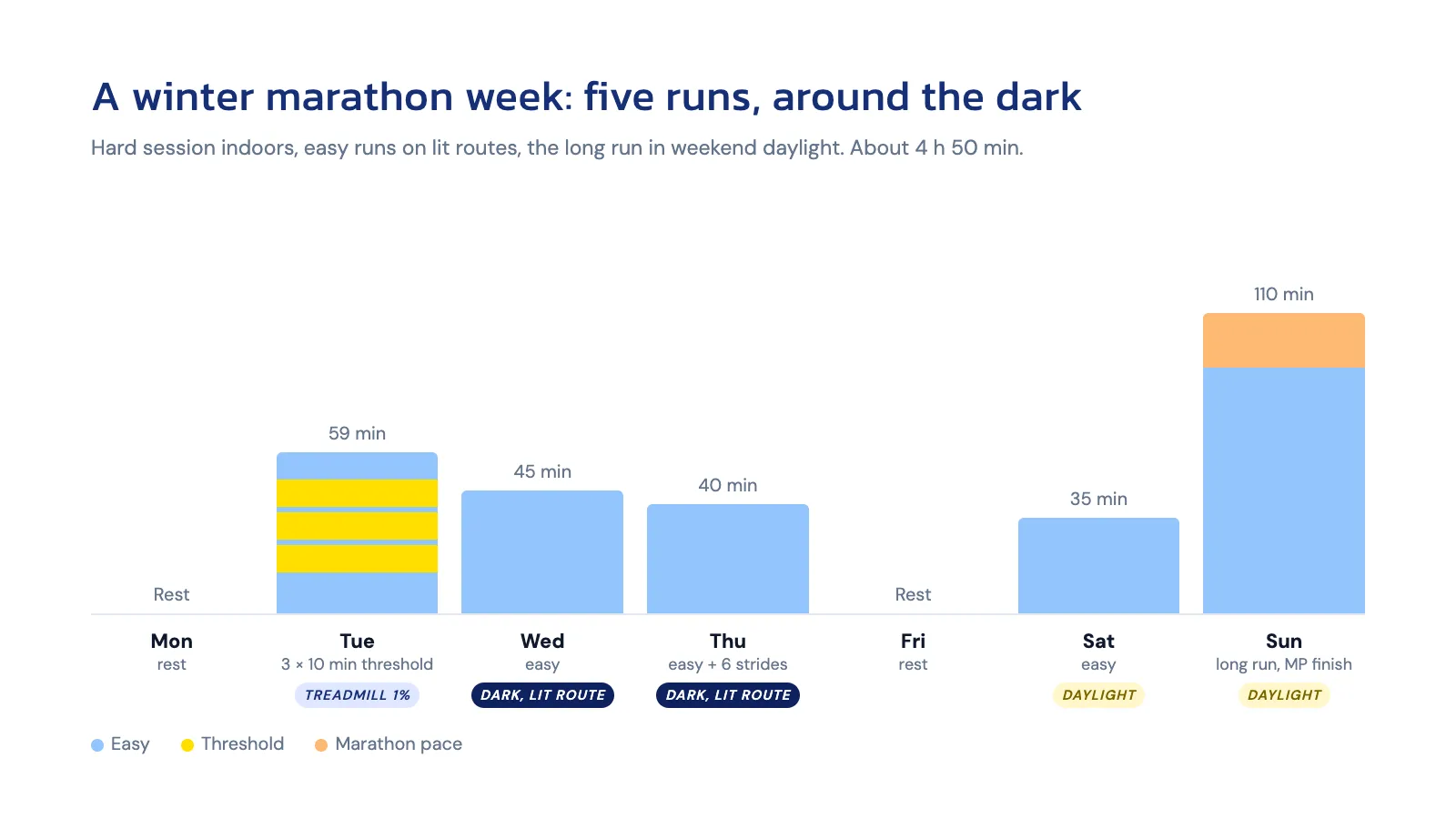
- Monday: rest.
- Tuesday: treadmill at 1%, 15 minutes easy, 3 × 10 minutes at threshold with 2 minutes' jog, 10 minutes easy.
- Wednesday: 45 minutes easy on a lit route, head torch and reflective kit.
- Thursday: 40 minutes easy with six strides.
- Friday: rest.
- Saturday: 35 minutes easy.
- Sunday: long run in daylight, 1 hour 50 minutes, with the last 20 minutes at marathon pace and race-day fuelling.
Threshold pace and marathon pace are different efforts, and our guide to threshold pace versus tempo pace explains where each sits. In March the volume comes down again, and the marathon taper guide covers the final weeks.
How Structur helps
Whether you are self-coached or working with a coach, Structur is there to help build a marathon plan from a training methodology and the date of your race. Four weeks in, it looks at what you actually ran and rebuilds the rest of the plan around it, so a lost Christmas week is absorbed rather than ignored. Workouts go to your Garmin or COROS watch, including the treadmill session. After each run, it scores how closely you hit the prescribed paces, rep by rep, so you can see whether the session did its job. See Structur for athletes for more.