


Zone 2 marathon training means running most of your weekly miles at an easy, conversational effort, so that the few hard sessions land on fresh legs. For most marathon runners that is roughly four runs in every five. The research behind that figure is better than you might expect, and this guide shows how to turn it into a real training week.
If you are new to the idea, start with our guide to zone 2 running. It covers how to find your zone 2 heart rate and why the pace feels slow. This article picks up where it leaves off: how zone 2 fits into a marathon build, week by week.
What zone 2 means for a marathon runner
The name causes more confusion than the training. Most watches and apps use five heart-rate zones, and zone 2 is the band just above a very easy jog. Sports scientists, however, usually divide effort into three zones, set by two measured thresholds.
In that research model, zone 1 is everything below the first threshold. Zone 2 is the band between the two thresholds, and zone 3 sits above the second. A systematic review of elite distance runners uses exactly these definitions. So when a study says "zone 1", it means roughly what your watch calls zone 2.
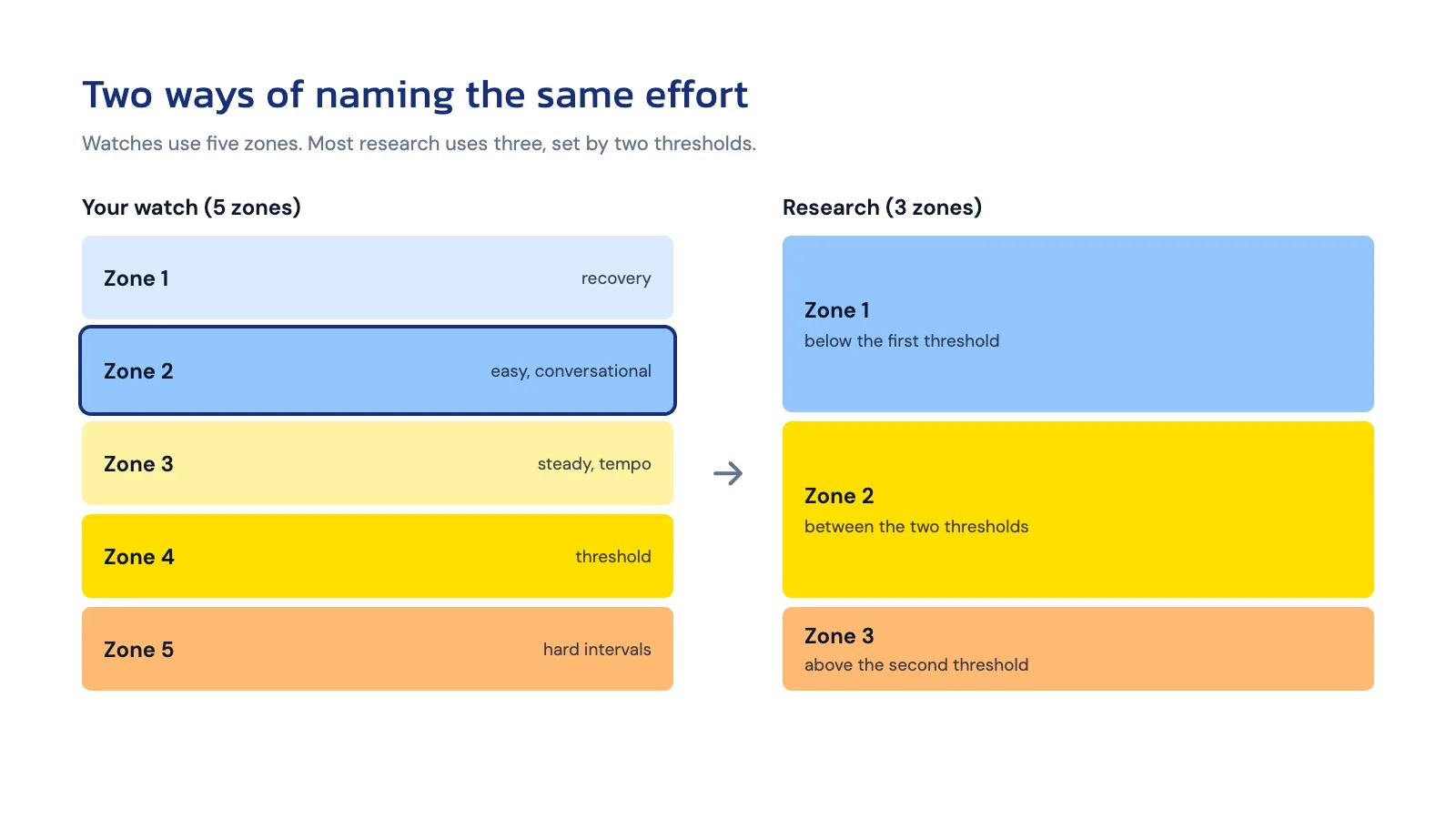
In practice, that means you can hold a conversation. Your breathing is steady, and you could keep going for a long time.
Is zone 2 a heart rate or a pace?
Zone 2 is an effort level, not a single number. Heart rate is the usual way to measure it, but you can also set it as a pace range or judge it by your breathing.
Heart rate is the default because it reflects how hard your body is working. On your watch, zone 2 is a heart-rate band. It is worked out from your maximum heart rate, or from your maximum and resting heart rates. Our zone 2 heart rate calculator gives you a starting range.
The pace that matches that effort is not fixed. It is slower on hills, in the heat and when you are tired. It also gets faster as your fitness improves. That is why the same zone 2 run can be noticeably slower on a warm summer day than in spring.
Pace works too, and many plans set easy runs as a pace range. It is simpler to follow, and it is not affected by heart rate lagging behind effort at the start of a run. The drawback is that a fixed pace ignores the conditions. On a hot or hilly day, the same pace costs more effort than it looks. Our training paces calculator gives you an easy-pace range from a recent race.
The best approach uses both. Set your zone 2 by heart rate, then learn what pace that usually gives you on flat ground. Use the pace as a guide, and if the two disagree, trust your heart rate and breathing and slow down. In the rest of this guide, "zone 2" means the heart-rate band.
How much of your training should be zone 2?
The best-known guide is around 80% of your running at low intensity. A 2022 review of how world-class distance runners train found that marathoners run 160 to 220 km a week in the middle of their preparation. Crucially, at least 80% of that volume is at low intensity, all year round.
You are not running 200 km a week, and you do not need to. Still, the pattern holds further down the field too. In a 2007 controlled trial, 12 sub-elite runners were split into two groups for five months. One group did about 80% of their training below the first threshold. The other did about 67% there and twice as much in the middle zone. Both groups did the same small amount of hard running.
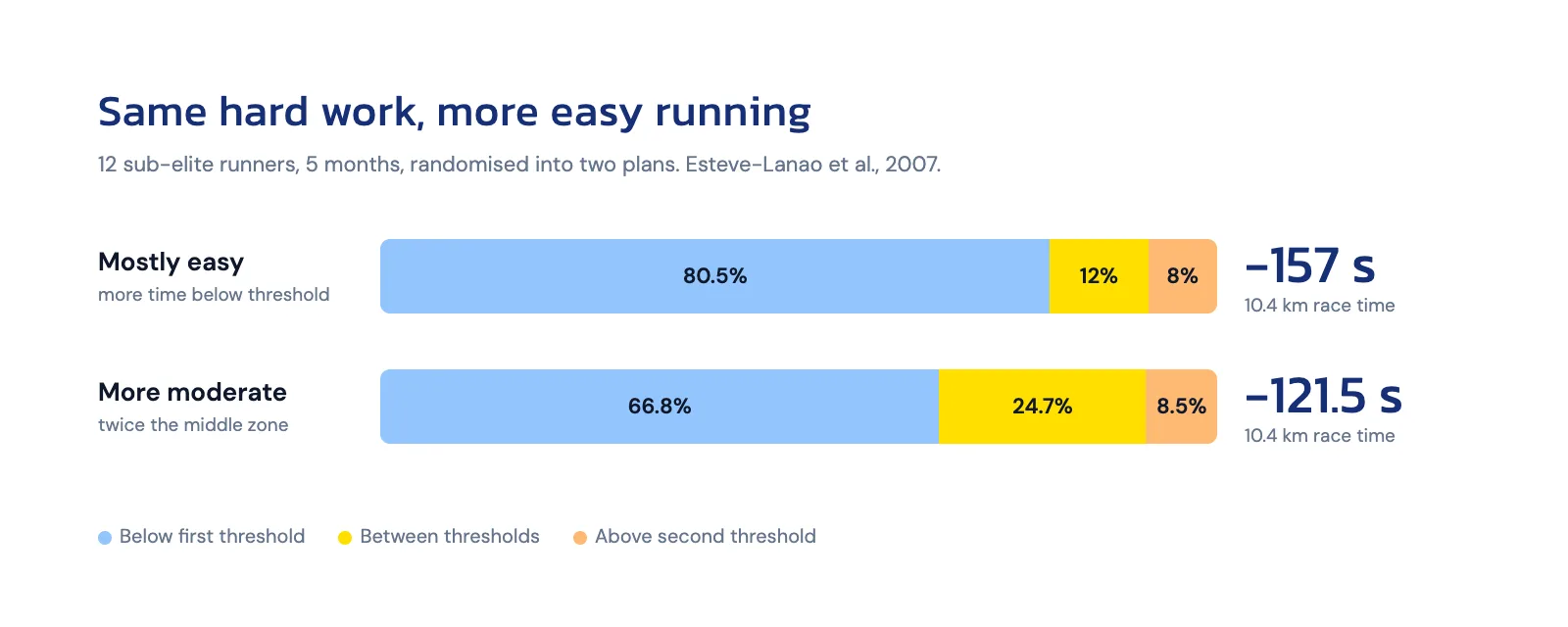
The low-intensity group improved their 10.4 km race time by 157 seconds. The other group improved by 121.5 seconds. Earlier work from the same group found that runners who spent more time at low intensity raced faster, although that study was small and only showed a link.
Recreational runners have been tested as well. A 10-week study of 30 recreational runners compared a mostly easy plan with a plan built around moderate efforts. Both groups got faster over 10 km. The difference between the groups was not statistically significant. However, the runners who followed the easy plan most closely improved the most.
So the honest summary is this. Easy volume does not replace hard work, but it supports it. Most of the benefit comes from keeping the easy days genuinely easy.
Why zone 2 marathon training works
A marathon is an aerobic event. A classic review of the physiology of marathon running points to three things: a high aerobic capacity, good running economy, and the share of that capacity you can hold for the whole race.
The same review highlights fuel. Carbohydrate stores are limited, so burning more fat at a given pace saves glycogen for the final miles. Large amounts of endurance training appear to drive exactly that adaptation.
Zone 2 is how you collect that volume without breaking down. Because the effort is low, you recover quickly. As a result, you can run more often, and the quality sessions get the attention they deserve.
Zone 2 long runs and heart-rate drift
The long run is the heart of zone 2 marathon training, and it is where most runners drift out of zone without noticing. Heart rate rises during long runs even when pace stays the same. A review of cardiovascular drift describes stroke volume falling after 10 to 20 minutes of exercise, while heart rate climbs to compensate.
That leaves you with a choice. You can slow down to keep your heart rate in zone 2, or you can hold your pace and accept a gradual climb. For most long runs, slowing down is the better option, especially in warm weather.
The size of the drift also tells you something. If your heart rate rises a lot on a steady run, your aerobic base still has room to grow. Our aerobic decoupling calculator turns a steady run into a single percentage you can track across a training block.
Zone 2 or zone 3: where does marathon pace sit?
For most runners, marathon pace is faster than zone 2. It feels controlled, but it is not conversational for three hours. That is why "zone 2 or zone 3" is one of the most searched marathon questions.
The answer is both, at different times. Elite plans keep the easy volume steady all year, but the volume of race-pace running increases as the main race approaches. Meanwhile, the systematic review found that marathoners lean towards a pyramidal pattern. In other words, there is a lot of easy running, a moderate amount of threshold work and a small amount of very hard running.
For an amateur, that means zone 2 is the foundation, not the whole building. Marathon-pace sections usually sit inside long runs in the second half of the plan. To find your current pace, try the marathon pace calculator or the training paces calculator.
A sample week of zone 2 marathon training
Here is a typical week for a runner aiming for around 3:45, in the middle of a 16-week plan. It has five runs and about 5 hours 25 minutes of running.
- Monday: rest, or 30 minutes of mobility.
- Tuesday: 50 minutes in zone 2, with 6 × 20-second relaxed strides at the end.
- Wednesday: threshold session. For example, 15 minutes easy, then 3 × 10 minutes at threshold pace with 2 minutes jogging, then 10 minutes easy.
- Thursday: 45 minutes in zone 2.
- Friday: rest.
- Saturday: 40 minutes in zone 2.
- Sunday: long run of 2 hours 10 minutes. Keep the first 100 minutes in zone 2, then run the last 30 minutes at marathon pace.
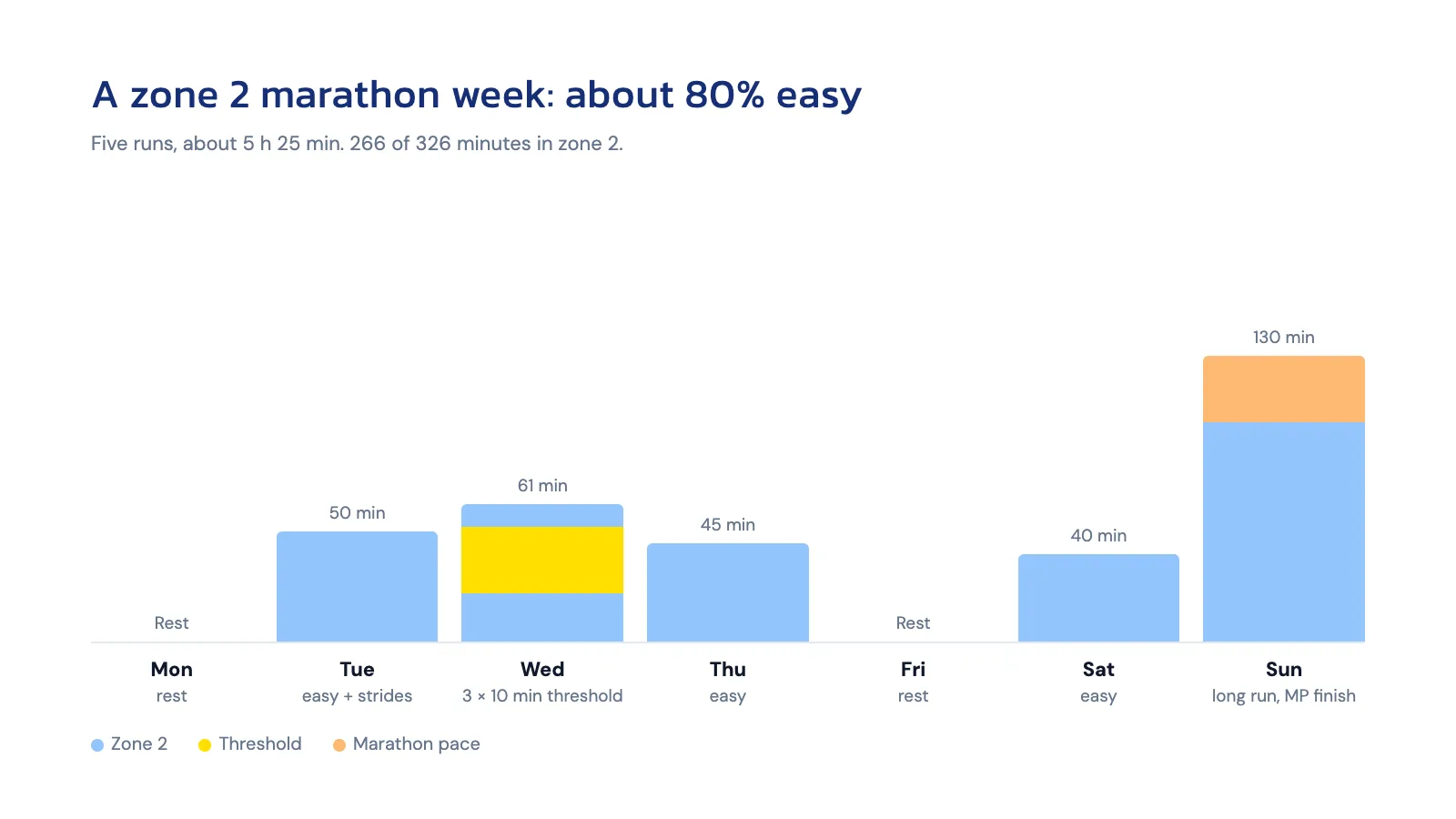
The threshold work and the marathon-pace section add up to about one hour. Everything else is easy, which keeps the week close to the 80/20 split. If you are unsure of your threshold pace, the threshold pace calculator estimates it from a recent race.
How many zone 2 runs a week, and how long?
The number of runs matters less than the total time and the balance between easy and hard. As a rule of thumb, most of your runs should be zone 2, and only one or two should be hard.
For a first marathon, three or four runs a week is a sensible start. Two of them can be short zone 2 runs of 30 to 45 minutes. The third is the long run. Add a fourth easy run once that feels routine, before you add any extra speed work.
For a runner chasing a time, five or six runs is more typical. Even then, only two sessions carry real intensity: one threshold or interval session, and the marathon-pace part of the long run. Everything else is zone 2.
As for length, a zone 2 run should be long enough to be worth the time. Around 40 to 60 minutes suits most weekday runs. The long run grows gradually across the plan. For most amateurs, around three hours is a sensible ceiling, because recovery from anything longer eats into the following week.
Finally, consistency beats heroics. Four zone 2 runs every week for four months will do more than one huge week followed by an injury.
The final eight weeks and the taper
As race day approaches, the shape of the week changes. Long runs include more marathon pace, and one quality session becomes more race-specific. Even so, the easy days stay easy, because that is what lets you absorb the harder work.
Elite marathoners usually begin their taper 7 to 10 days before the race. Most amateurs reduce volume over two or three weeks. Our marathon taper guide sets out a week-by-week plan.
Common mistakes with zone 2 marathon training
Running easy days too fast. This is the most common mistake. A study of junior skiers found that well-trained athletes spend surprisingly little time at threshold, and their easy days stay well below it. Most amateurs do the opposite and run every day at the same medium effort.
Chasing a heart-rate number on every hill. Heart rate lags behind effort. On hills, judge effort by breathing and let the number settle afterwards.
Ignoring heat and fatigue. Your heart rate runs higher in warm weather and when you are tired. On those days, slow down instead of forcing the usual pace.
Dropping the quality sessions. Zone 2 builds the base. You still need threshold work and marathon-pace running to race well.
How Structur helps
Structur lets you build sessions with heart-rate or pace targets, including zone 2 ranges, and sends them to your Garmin or COROS watch. After each run, your Insights show your heart-rate zones and aerobic decoupling, and every session is scored against what was prescribed. It works the same way whether you train with a coach or coach yourself. See how it works for coaches and for self-coached athletes.