

An SIS Beta Fuel marathon plan comes down to two numbers: about 60 to 90 grams of carbohydrate an hour, and one gel every 25 to 30 minutes to get there. Each Beta Fuel gel carries 40 grams, so a 3:30 runner needs seven. The Nootropics gel counts as one of them. Its caffeine is the part with real evidence behind it, and the best time to take it is about two hours in.
This guide covers what is in each product, how much to take, a race-day timeline, and an honest look at the Nootropics gel. It also covers how much of that gel's effect is caffeine, how much is belief, and why that matters less than you might think.
The SIS Beta Fuel range for the marathon
Beta Fuel is the high-carbohydrate end of the Science in Sport range. Every product uses the same mix of two sugars: maltodextrin and fructose in a 1:0.8 ratio. A 40 g gel therefore holds roughly 22 g of maltodextrin and 18 g of fructose.
The range, from SIS's own product pages:
- Beta Fuel gel: 40 g of carbohydrate in a 60 ml gel.
- Beta Fuel + Electrolyte gel: 40 g of carbohydrate and 200 mg of sodium, for warm days.
- Beta Fuel + Nootropics gel: 40 g of carbohydrate, plus 200 mg of caffeine and three other active ingredients.
- Beta Fuel chews: 45 g of carbohydrate per pack, in blocks of 7.5 g.
- Beta Fuel 80: a drink mix with 80 g of carbohydrate per sachet.
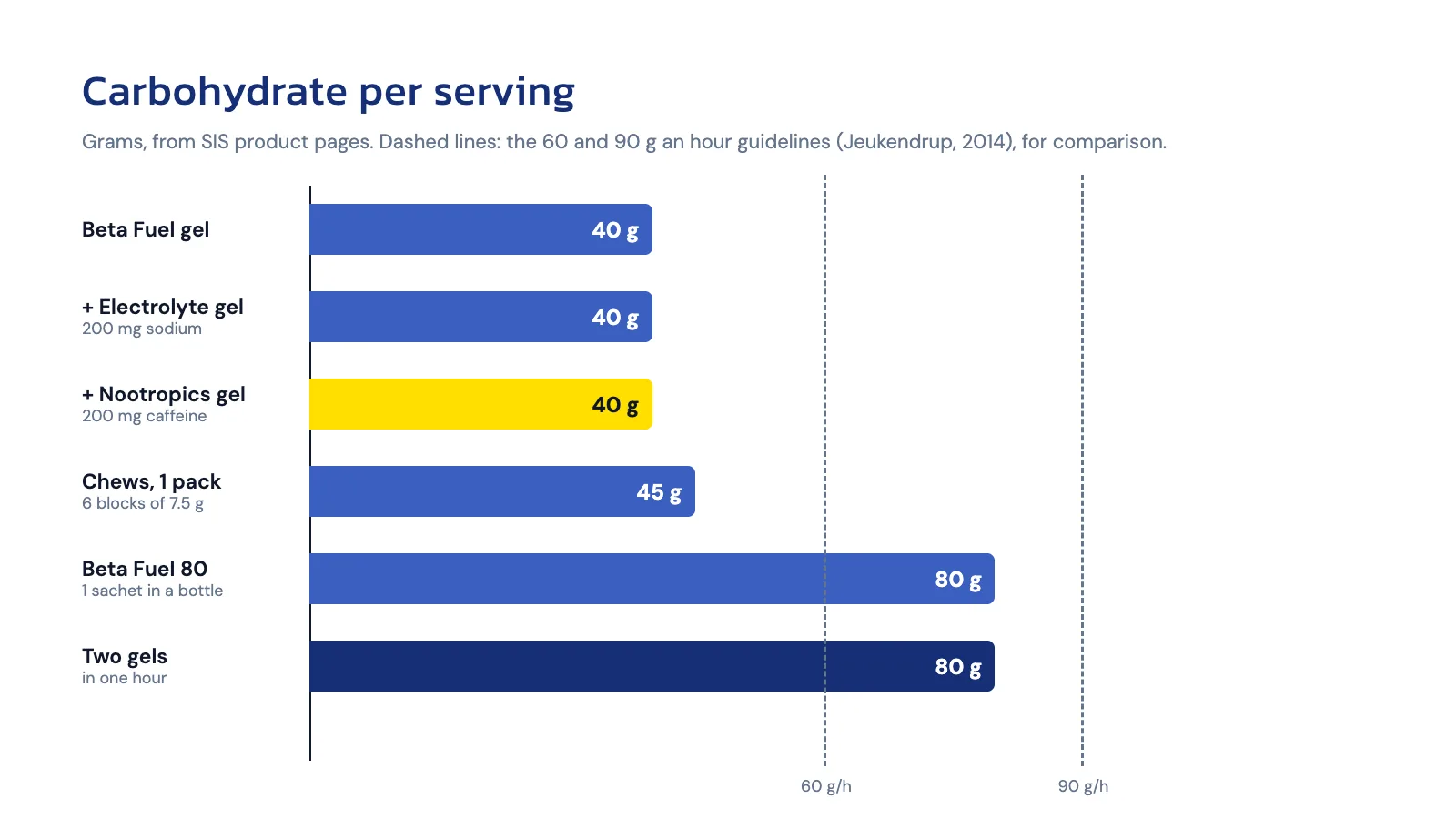
SIS suggests one to three gels an hour, aiming for 80 to 120 g. For an SIS Beta Fuel marathon plan, that upper figure is higher than most marathon runners need, and the next section explains why.
Why two sugars matter
Your gut absorbs glucose and fructose through different transporters. Glucose, including maltodextrin, uses one route. Fructose uses another. A single sugar source can only be used at about 60 g an hour, according to a review of carbohydrate intake during exercise by Asker Jeukendrup. Above that, the extra sugar sits in the gut, which is how stomach problems start.
The 1:0.8 ratio has its own evidence. In a study comparing three fructose-to-maltodextrin ratios, ten cyclists rode for 150 minutes while taking 1.8 g of carbohydrate a minute. The 0.8 ratio raised carbohydrate use by about 10% against the other two mixes. Stomach fullness, cramping and nausea were also lowest on the 0.8 mix.
Two caveats apply. First, the study involved ten male cyclists, not marathon runners. Second, a 2015 review of 14 such studies found that the evidence comes from intakes of about 78 g an hour or more. Below that, the benefit has not really been tested.
How many SIS Beta Fuel gels for a marathon?
For a marathon on SIS Beta Fuel, aim for 60 to 90 g of carbohydrate an hour. Jeukendrup's guidance is about 60 g an hour for events of two to three hours. For longer efforts, the figure rises to about 90 g, provided the carbohydrate comes from more than one sugar. Beta Fuel is built for exactly that.
In gels, that means:
- Sub-3:00: six gels, about one every 25 minutes.
- 3:30: seven gels, one every 25 to 30 minutes.
- 4:00 and slower: eight gels, one every 30 minutes.
You do not need to stop at gels. A pack of chews works well in the first hour, because blocks are easy to spread out. Equally, Beta Fuel 80 in a bottle suits runners who carry their own drinks.
Is 120 g an hour better? The evidence is thin. In one trail marathon study, 26 elite runners took 60, 90 or 120 g an hour. The 120 g group recovered better over the next 24 hours, but the study did not test race times. So for a road marathon, 90 g an hour is a sensible ceiling. Go higher only if your gut has handled it in training.
Rehearse your SIS Beta Fuel before the marathon
The gut adapts to carbohydrate in the same way your legs adapt to mileage. In a two-week gut-training trial, endurance runners took carbohydrate during exercise every day. Afterwards their stomach symptoms fell. Their distance in a one-hour test also improved by 5.2%, while the placebo group got 2.1% worse.
In practice, take gels on every long run from about ten weeks out. Start at one gel an hour and add one every week or two. By your last three long runs, you should be taking exactly the SIS Beta Fuel you plan to use in the marathon. That includes the Nootropics gel, at the same point in the run.
An SIS Beta Fuel marathon timeline
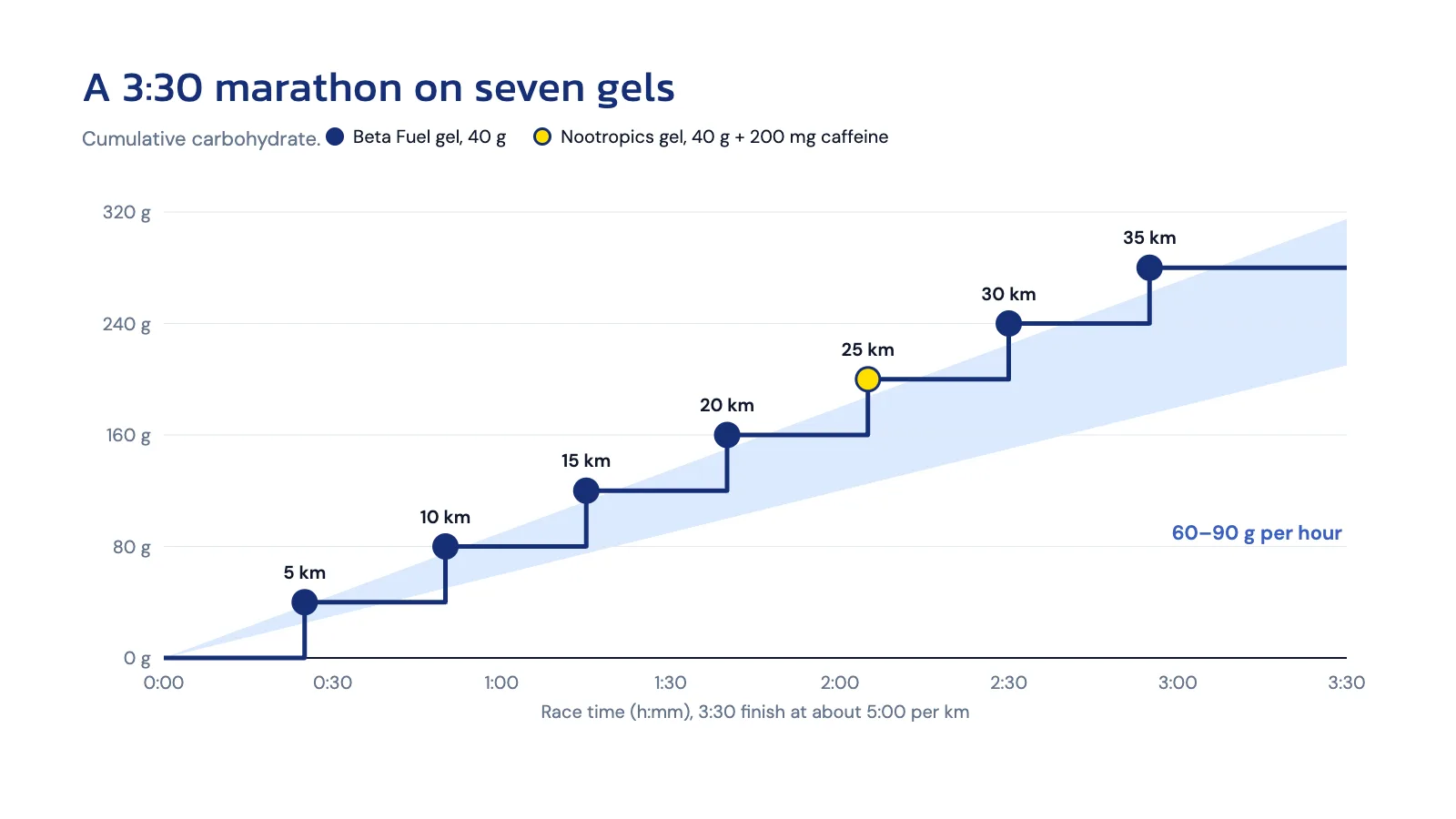
Here is a plan for a 3:30 marathon, about five minutes per kilometre. It uses seven gels, or 280 g of carbohydrate in total, which works out at 80 g an hour.
- Before the start: a carbohydrate breakfast you have rehearsed, then water.
- 0:25 (5 km): Beta Fuel gel.
- 0:50 (10 km): Beta Fuel gel.
- 1:15 (15 km): Beta Fuel gel.
- 1:40 (20 km): Beta Fuel gel, or the Electrolyte gel if it is warm.
- 2:05 (25 km): Beta Fuel + Nootropics gel.
- 2:30 (30 km): Beta Fuel gel.
- 2:55 (35 km): Beta Fuel gel.
Take each gel just before a water station, then drink a few mouthfuls. After 35 km, most runners need nothing more. To find your own split times, use our marathon pace calculator. If you are not sure what time to plan for, start with the race time predictor.
What the Nootropics gel claims to do
SIS describes the gel as fuel for body and mind. Besides the carbohydrate, it contains four active ingredients:
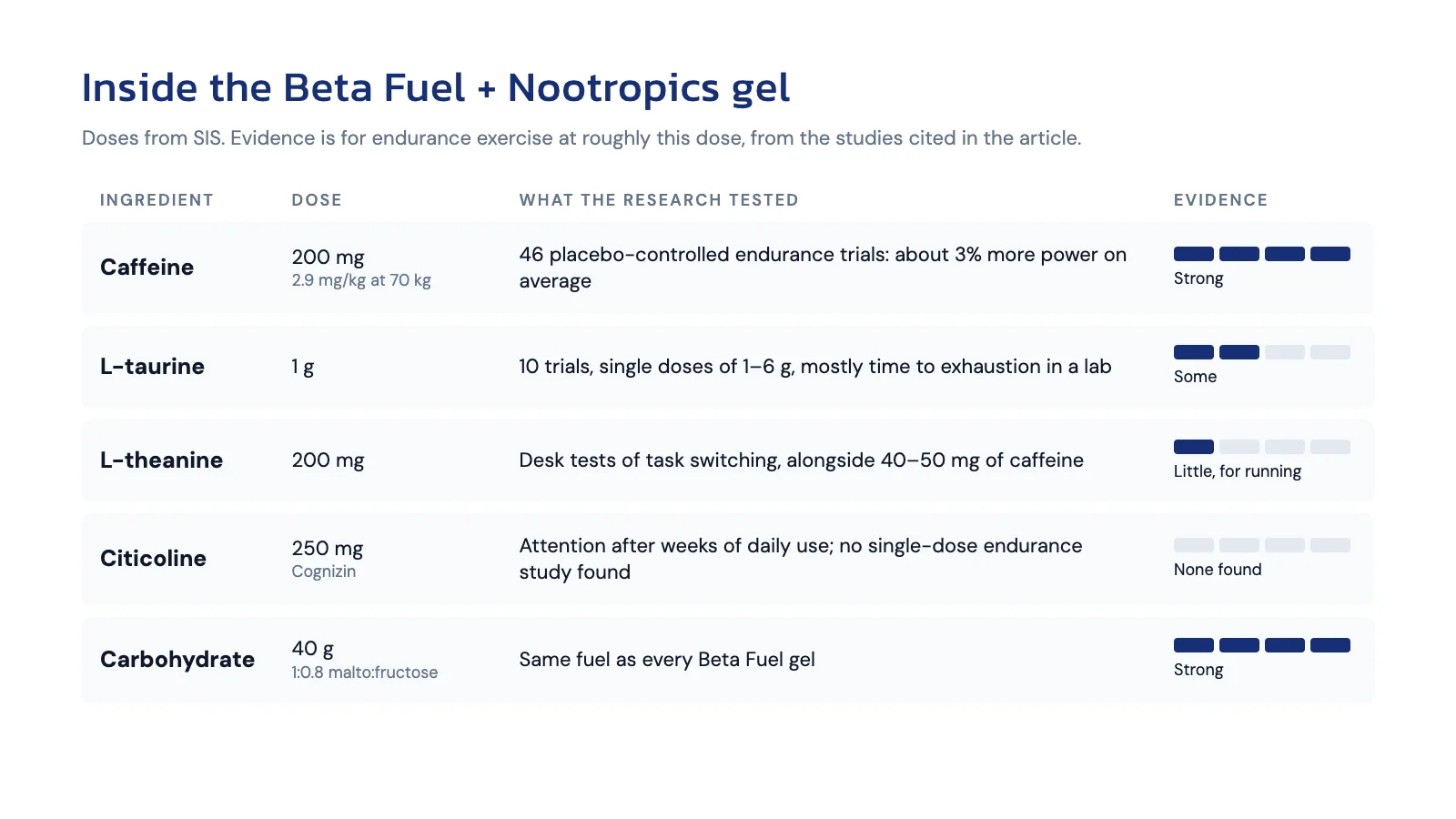
- Caffeine, 200 mg. About the same as a large filter coffee.
- L-theanine, 200 mg. An amino acid found in tea.
- Cognizin citicoline, 250 mg. A branded form of a compound linked to brain chemistry.
- L-taurine, 1 g. An amino acid found in many energy drinks.
According to the Nootropics gel product page, the mix increases alertness and reduces the jitters of caffeine alone. SIS also sets a limit of one gel a day.
Does it work? The evidence, ingredient by ingredient
Caffeine: yes, and it is the main event
Caffeine is one of the best-studied aids in sport. The International Society of Sports Nutrition position stand found that endurance exercise shows the most consistent benefit. Effective doses run from 3 to 6 mg per kilogram of body weight, and possibly as low as 2 mg. The stand also notes that caffeine in gels and chews works.
For a 70 kg runner, 200 mg is just under 3 mg per kilogram. That is inside the effective range. A 2018 meta-analysis of 46 placebo-controlled studies put the average gain at 3% in power and 2.2% in time-trial performance. Moreover, a 2019 analysis found that the effect grows as the event gets longer.
Taurine: some evidence, at the low end of the dose
A meta-analysis of ten studies found that a single dose of taurine, between 1 and 6 g, improved endurance performance. The effect was small to moderate, and the dose did not seem to matter. However, most of the trials measured time to exhaustion in a lab, not racing. So the 1 g in this gel may help a little, but that is not proven in a marathon.
Theanine: helps the head, not the legs
Theanine has been studied mostly with caffeine, at a desk. In two small trials, a theanine and caffeine mix improved accuracy when switching between tasks. One of them found no gain in how alert people felt. Those trials also used far less caffeine than this gel. There is no good evidence that theanine makes you run faster. Its likely job is to take the edge off the caffeine.
Citicoline: the weakest link
Citicoline research has looked at attention after weeks of daily use, much of it funded by the maker. We found no study of a single dose during endurance exercise. At present, the citicoline in this gel is a reasonable idea without the evidence to back it.
Is it all placebo?
Partly, and that is not the insult it sounds like. Researchers have tested this directly. In a placebo study with trained cyclists, six riders were told they would get no caffeine, a moderate dose or a high dose. In fact, every capsule was a placebo.
The results followed belief, not chemistry. Riders who thought they had the high dose produced 3.1% more power than at baseline. Those who thought they had none produced 1.4% less.
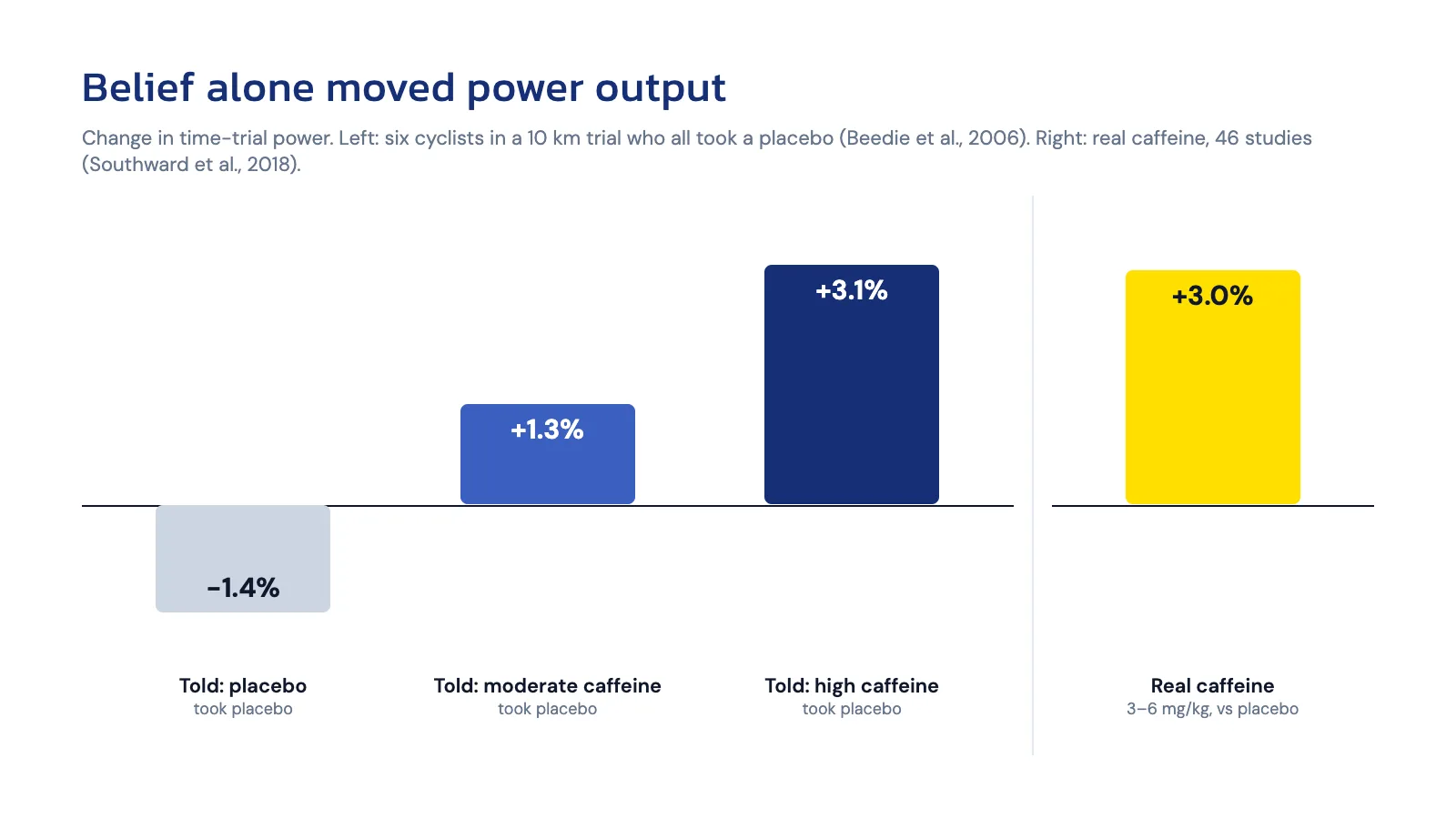
Six riders is a tiny sample, so treat it as a signal. Even so, a 2018 review of caffeine expectancy studies found the same pattern. Thirteen of 17 studies showed an expectancy effect, and in many it was as large as the drug itself.
So what does that mean for the SIS Beta Fuel Nootropics gel in a marathon? First, the caffeine works in placebo-controlled trials, so its benefit is not only belief. Second, believing in it probably adds to that benefit. Third, the three other ingredients have little evidence of their own, so any lift you feel from them is more likely to be expectation. A cheaper caffeine gel would probably do almost as much. That said, if this gel is the one you trust, your trust is part of what makes it work.
When to take the SIS Beta Fuel Nootropics gel in a marathon
Take it between 1:45 and 2:15 into the marathon, which is roughly 20 to 28 km for most runners. There are three reasons.
First, caffeine takes time to work. The most common timing in research is 60 minutes before exercise. Taken at two hours, its effect lands in the last 10 km, when the race gets hard.
Second, late caffeine still works. In one study, cyclists given a small dose of caffeine in the last 40 minutes of a two-hour ride improved about as much as those given a large dose beforehand.
Third, fatigue is greatest at the end. That is where staying alert, keeping pace and making good decisions matter most.
A few cautions apply. Do not take two in one race, because SIS sets a limit of one a day. Count any coffee you have at breakfast too. The European Food Safety Authority considers single doses of up to 200 mg safe for healthy adults, including before hard exercise, and up to 400 mg across a day. And never try it for the first time on race day.
Where Structur fits
Structur does not plan your nutrition. What it does is put the long runs where you rehearse your fuelling into a structured plan, send them to your Garmin or COROS watch, and show you how closely each one was run. A long run with a fuelling rehearsal can be a planned session like any other. For the final weeks, our guide to the marathon taper covers what to cut and what to keep. The aerobic decoupling guide explains how to see whether your pace held up late in a long run.